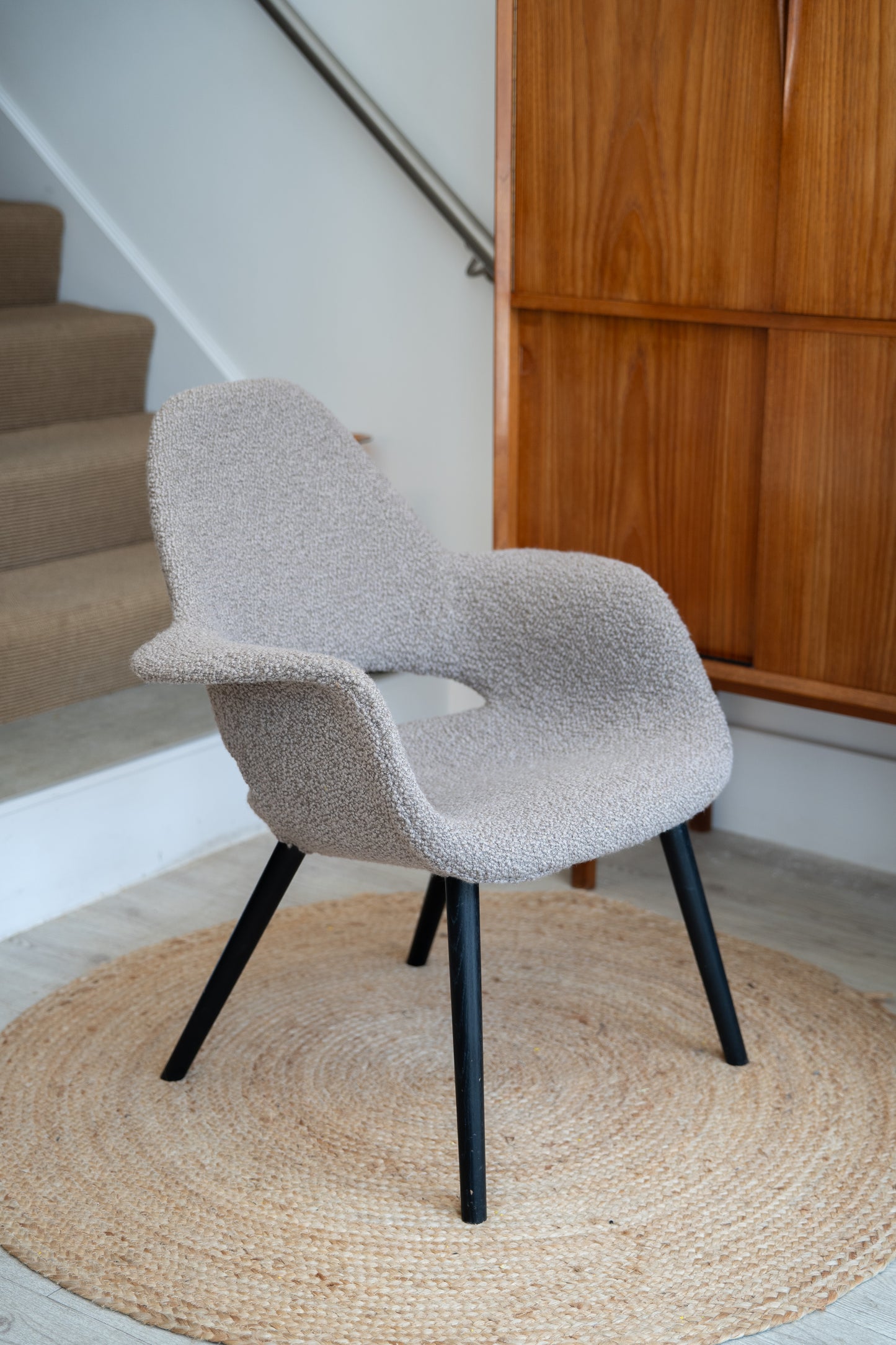


'Organic' Highback Reading Chair by Charles Eames & Eero Saarinen for Vitra
'Organic' Highback Reading Chair by Charles Eames & Eero Saarinen for Vitra
Eames & Saarinen Organic High Back Reading Chair for Vitra
Originally designed in 1940 by Charles Eames and Eero Saarinen, the Organic Chair is one of the most important and influential seating designs of the twentieth century.
Created for the Museum of Modern Art’s Organic Design in Home Furnishings competition in New York, the chair was revolutionary in its approach to comfort. Rather than relying on a rigid frame, Eames and Saarinen developed a sculptural, human-centred form that supported the body naturally, anticipating many of the moulded seating designs that would define post-war furniture design.
Although the chair won first prize in the competition, the technology required to manufacture its complex organic shell did not yet exist at a commercial scale, and the design remained largely unproduced until decades later. It was eventually brought into production by Vitra who continue to manufacture the chair under licence today.
This example bears the Vitra manufacturer’s label and has been completely reupholstered in a luxurious Romo bouclé. The tactile fabric complements the chair’s soft, sculptural form, highlighting the flowing curves that made the design so groundbreaking. The textured upholstery adds warmth and depth while remaining sympathetic to the chair’s modernist origins.
The black stained legs provide a subtle contrast to the pale bouclé and emphasise the chair’s distinctive silhouette.
Condition
Professionally and completely reupholstered in Romo bouclé upholstery. Presented in excellent condition throughout. Vitra manufacturer’s label present.
Designers
Charles Eames (1907-1978)
Charles Eames is widely regarded as one of the most influential designers of the twentieth century. Born in St Louis, Missouri, he initially studied architecture before establishing a design practice that would ultimately transform furniture, architecture, exhibitions, film and industrial design.
In partnership with his wife Ray Eames, he became known for pioneering new manufacturing techniques, particularly the moulding of plywood and later fibreglass. Their furniture designs for Herman Miller in America and Vitra in Europe remain among the most recognisable and widely collected pieces of modern design.
Beyond furniture, the Eameses produced more than one hundred films, designed exhibitions for major institutions including IBM and the Smithsonian, and developed educational projects that explored science, mathematics and communication. Charles Eames famously described design as “a plan for arranging elements to accomplish a particular purpose”, a philosophy that continues to influence designers today.
Eero Saarinen (1910-1961)
Eero Saarinen was born in Finland and moved to the United States as a child when his father, the architect Eliel Saarinen, emigrated to teach at the Cranbrook Academy of Art in Michigan. Cranbrook would become one of the most important centres of modern design in America and was where Saarinen met Charles Eames and many of the figures who would shape twentieth-century design.
Although best known as an architect, Saarinen made a profound contribution to furniture design. His work was driven by a desire to simplify form and eliminate visual clutter, leading to some of the most innovative furniture of the post-war period. His celebrated Pedestal Collection for Knoll, including the Tulip Chair and Tulip Table, sought to remove what he called the “slum of legs” found beneath conventional furniture.
As an architect, Saarinen designed some of the most iconic buildings of the modern era, including the TWA Flight Center at New York’s JFK Airport, the Gateway Arch in St Louis and the General Motors Technical Center in Michigan. His furniture designs demonstrate the same sculptural quality and concern for form that characterised his architecture.
Dimensions W: 730 x D: 680 x H: 830 mm
Couldn't load pickup availability