

Jim Malone (1946) Stoneware Teapot, Ainstable Pottery
Jim Malone (1946) Stoneware Teapot, Ainstable Pottery
Jim Malone (b.1946) Stoneware Teapot, Ainstable Pottery
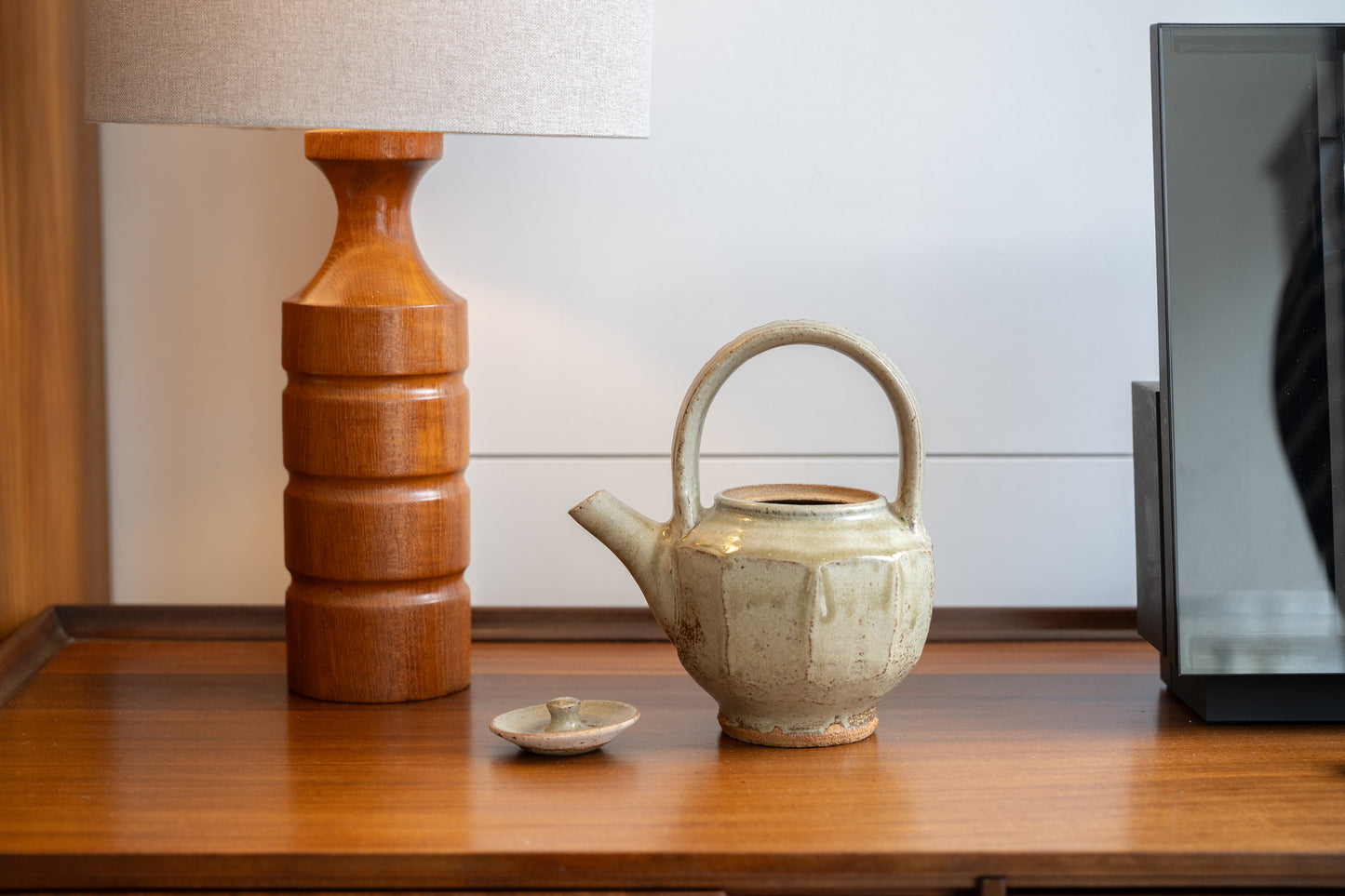
A hand thrown stoneware teapot by Jim Malone, made at Ainstable Pottery in the Eden Valley, Cumbria. The piece is finished in a soft ash glaze, pale and luminous, with the natural variation in tone and surface that comes from wood and oil firing rather than any attempt at uniformity.
The form has a broad, stable body with a gently angled spout and a bold loop handle that gives the pot a strong silhouette.
Impressed potter’s marks to the foot rim, including the distinctive Ainstable Pottery seal, authenticate the piece and place it within a specific and significant period of Malone’s practice.
Condition
In very good vintage condition with no chips, cracks or repairs.
Dimensions
Height: 21.5cm
About the Maker
Jim Malone was born in Sheffield in 1946 and studied ceramics at Camberwell School of Arts and Crafts, graduating with first class honours. He spent time at Winchcombe Pottery under Ray Finch before establishing his first studio in Wales, later moving to Cumbria in 1982 to teach at Cumbria College of Art alongside Mike Dodd. In 1984 he set up his studio at Ainstable in Cumbria, where he remained until the early 2000s.
Working with a self built wood fired kiln and glazes including tenmoku, kaki, wood ash and hakame, Malone produces traditional studio pottery rooted in historical reference, particularly sixteenth century Korean, thirteenth century Chinese and medieval English ceramics. His influences are firmly oriental, and he works primarily in stoneware with incised and brushed decoration.
His work is held in the collections of the V&A, the Ulster Museum, Manchester Metropolitan University, and Liverpool Museum and Art Gallery, and he is widely regarded as one of the most important British studio potters of his generation. The Ainstable mark, as seen on this piece. is among the most recognised in British studio ceramics collecting.
Couldn't load pickup availability